VMD Voices: Our Experts Explain
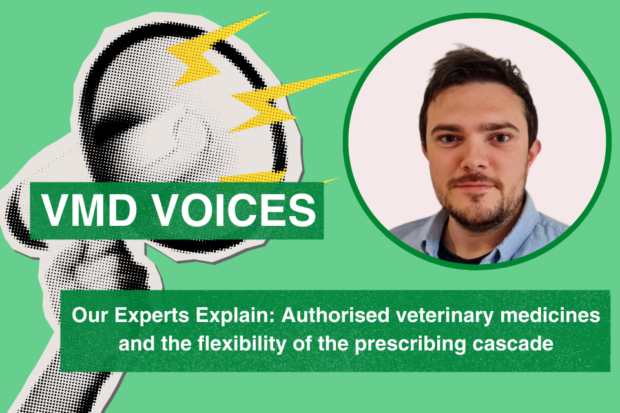
Welcome to the second blog in our 'VMD Voices: Our Experts Explain' series, where you'll hear from specialists across the Veterinary Medicines Directorate (VMD), from scientists and vets to enforcement and intelligence officers.
In this blog, aimed particularly at veterinary surgeons, we hear from Dr. Jon Haycock MRCVS, a VMD Senior Veterinary Assessor with several years of clinical practice under his belt. Jon has now turned his hand to supporting the VMD to take decisions that benefit animal health and importantly, support vets in practice.
About Jon
I graduated from the Royal Veterinary College, University of London, in 2011 with degrees in both Veterinary Sciences and Veterinary Medicine. After a decade in practice and academia, I joined the VMD in 2021 as a veterinary assessor, responsible for assessing marketing authorisation applications for pharmaceutical veterinary medicinal products, and clinical trials of veterinary medicines.
I still work part-time in small animal first opinion practice and have a strong interest in engaging with veterinary professionals on the little-known but crucial ‘behind-the-scenes’ work of the VMD, and how it supports daily life in practice. Most recently, I spoke at the London Vet Show 2025, where I had the opportunity to discuss the prescribing cascade directly with vets – a conversation that helped inspire this blog.

The veterinary medicines regulatory framework and how it supports vets
As a veterinary surgeon myself, I understand the daily challenges of clinical practice, where prescribing decisions involve balancing clinical need, client expectations, and wider practical considerations. That's why I want to clarify that the veterinary medicines regulatory framework, including the prescribing cascade, fundamentally exists to protect us as vets, our patients, and the public, whilst fully enabling us to fully exercise our professional clinical judgement.
Balancing affordability with clinical standards
I genuinely appreciate the very real affordability concerns for some animal owners and recognise how these concerns can weigh heavily on both clients and veterinary professionals. However, affordability concerns must be balanced against well-established clinical and regulatory standards that exist to protect animals, their owners, and wider public health.
It’s important to recognise that the veterinary medicines sector is privately funded, with market forces and competition controlling medicine prices. There are no legislative controls for what a client pays for the veterinary medicines they require. The VMD’s role is to ensure that, whatever prescribing decisions we make, they are underpinned by appropriate regulatory safeguards.
What sets authorised veterinary medicines apart
Marketing authorisations (sometimes known as licences) for veterinary medicines are granted following a comprehensive, objective, and robust assessment of quality, safety, and efficacy data, specific to the product, target species, and indication. This results in veterinary medicines being authorised with reliable, product- and species-specific usage recommendations for specific conditions.
I appreciate that it might otherwise seem that authorised human products or extemporaneous veterinary products (including 'specials') containing the same active substance(s) should work ‘just as well’. However, it's not that straightforward. Safety risks may arise from other components (excipients) of a particular product and we’re all well-aware of how different species can react differently to the same substance: xylitol serving as a classic example.
What many may not realise is the quality and quantity of evidence supplied to the VMD, and its subsequent independent assessment, for the authorisation of veterinary medicines. Far from a simple box-ticking exercise, this process surpasses the evaluation of publicly available data that may otherwise be used to support cascade use of human medicines or 'specials'.
On a related note, it's important to note that 'specials' are not in fact authorised veterinary medicines, because they are not assessed by the VMD in terms of their safety or efficacy.
This doesn't mean human medicines or 'specials' cannot be sufficiently safe and efficacious to justify their veterinary use. However, differences in the supporting data and its objective evaluation by the VMD mean that, when used as recommended, authorised veterinary medicines will in almost all cases be reliably safer and more effective. These assurances represent one of the most tangible benefits to us, as vets at the coal face, of the VMD's authorisations process. It automatically provides us with an often underappreciated degree of confidence in the products on our dispensary shelves.
Beyond authorisation, the UK's robust legislative framework also enables the VMD to continuously monitor authorised veterinary medicines through pharmacovigilance activities. Human medicines used in animals do not receive an equivalent, legally mandated oversight.
The cascade is designed to support our clinical judgement
For the reasons described above, we, as vets, are legally required to consider prescribing authorised veterinary medicines available in our territory (GB/NI/UK-wide) for the specific species and condition in front of us before we consider using any other medicines. After all, the authorised products have the most robust, species- and indication-specific data.
However – and this is crucial – the cascade has always been designed to provide us with professional flexibility. When no suitable veterinary medicine is available, to avoid unacceptable suffering, we are permitted to use our clinical judgement to treat animals under our care in accordance with the cascade. To address a common misconception, this is also justifiable when an authorised veterinary medicine is available but is not considered to be the most clinically appropriate. However, the prescribing cascade must always be applied on a case-by-case basis, following a clinical assessment.
As a clinician, I fully understand that prescribing decisions are rarely black and white. In this context, the cascade has always allowed us to prescribe the most clinically appropriate product, whilst providing a risk-based decision tree, to reflect the cumulative risks and responsibilities we assume with each subsequent step. It provides us with a framework, unique to veterinary surgeons, that facilitates the legal use of otherwise unauthorised medicines, including those authorised for use in humans and 'specials'.
When prescribing under the cascade, we must not only consider the patient, but also any additional risks to the owner and/or the person administering the medicine, any consumers of produce from treated food-producing animals, wider public health, and the environment.
The cascade and costs
I also want to clarify something that causes frequent confusion, if not contention: the VMD's position that we, as vets, are not allowed to prescribe a medicine simply because it is cheaper. This position exists to prevent purely economic motivations from overriding existing clinical and safety considerations. Vets have no legal authority to independently assess an owner’s finances – pre-emptively or otherwise –and individual circumstances can vary considerably. Ultimately, the primary justification for prescribing under the cascade must be clinical, as this is what we’re qualified for.
Overall, the cascade has always existed to protect us, our patients, and the public, whilst supporting our professional autonomy whilst ensuring legal and clinical integrity.
Here to support you
Drawing on the wealth of veterinary expertise across the organisation, the VMD is committed to supporting the wider veterinary profession. We understand that in an industry of highly trained, conscientious, and responsible professionals, the value of an underlying regulatory framework can sometimes be overlooked. However, the veterinary medicines authorisations process and the cascade both fundamentally exist to protect animal health, public health, and environmental safety, whilst enabling and supporting every veterinary professional in exercising our own clinical judgement.
The VMD always places significant value on input from the profession to continually inform evidence-based regulatory decisions. The VMD wants to support all veterinary professionals in making the best clinical decisions for the animals in our care, within a framework that protects everyone involved.
If you have questions about prescribing under the cascade or any aspect of veterinary medicines regulation, please don't hesitate to contact the VMD today.
For more information on the Veterinary Medicines Regulations and the prescribing cascade, please visit our official guidance: